
 فونیکس وردپرس | شروع کسب و کارت از همین الان!
to two different five-minute extracts and you will answer six multiple- choice questions for each extract. Reading sub-test The Reading sub-test consists of three parts, with a total of 42 question items. You are given 60 minutes to complete all three parts (15 minutes for Part A and 45 minutes for Part B and Part C). The Reading sub-test has the following structure: Part A – expeditious reading task Part A assesses your ability to locate specific information from four short texts in a quick and efficient manner. The four short texts relate to a single healthcare topic, and you must answer 20 questions in the allocated time period. The 20 questions consist of matching, sentence completion and short answer questions. Part B and Part C – careful reading tasks Part B assesses your ability to identify the detail, gist or purpose of six short texts sourced from the healthcare workplace (100-150 words each). The texts might consist of extracts from policy documents, hospital guidelines, manuals or internal communications, such as email or memos. For each text, there is one three-option multiple-choice question. Part C assesses your ability to identify detailed meaning and opinion in two texts on a topic of interest to healthcare professionals (800 words each). For each text, you must answer eight four-option multiple choice questions.52 fi-fl–– 1 Extract 2: Questions 13–24 You hear a GP talking to a new patient called Mike Royce. For questions 13–24, complete the notes with a word or short phrase. You now have thirty seconds to look at the notes. Patient Mike Royce New patient transferring from another practice Description of initial symptoms • severe left knee pain in (13) area • worsened after an accident at work • developed (14) on back of knee (described as trigger points.) Impact on daily life • unable to (15) while working (house painter) • problems climbing ladders Initial treatment • exercise programme including – stretching exercises – rest • (16) for pain Developments in condition • GP suspected (17) • prescribed hospital-based rehabilitation • temporary improvement noted Current condition Suggeste That is the e33PRACTICE TEST 1 Part B In this part of the test, there are six short extracts relating to the work of health professionals. For questions 1-6, choose answer (A, B or C) which you think fits best according to the text. 1. If vaccines have been stored incorrectly, A this should be reported. B staff should dispose of them securely. C they should be sent back to the supplier. Manual extract: effective cold chain The cold chain is the system of transporting and storing vaccines within the temperature range of +2°C to +8°C from the place of manufacture to the point of administration. Maintenance of the cold chain is essential for maintaining vaccine potency and, in turn, vaccine effectiveness. Purpose-built vaccine refrigerators (PBVR) are the preferred means of storage for vaccines. Domestic refrigerators are not designed for the special temperature needs of vaccine storage. Despite best practices, cold chain breaches sometimes occur. Do not discard or use any vaccines exposed to temperatures below +2°C or above +8°C without obtaining further advice. Isolate vaccines and contact the state or territory public health bodies for advice on the National Immunisation Program vaccines and the manufacturer for privately purchased vaccines. OPTOMETRY3www.occupationalenglishtest.org Writing sub-test The Writing sub-test consists of one profession specific task based on a typical workplace situation. The writing test takes 45 minutes to complete – 40 minutes to write your letter and 5 minutes at the start to read the case notes on which to base you writing. The Writing sub-test has the following structure: The task is to write a letter, usually a referral letter but sometimes a different type of letter such as a letter of transfer or discharge. Along with the task instructions, you will receive stimulus material (case notes and/or other related documentation) which includes information to use in your response. Speaking sub-test The Speaking sub-test consists of two profession specific role-plays and is delivered individually. It takes around 20 minutes to complete. In each role-play, you take your professional role (for example, as a nurse or as a pharmacist) while the interlocutor plays a patient, a client, or a patient’s relative or carer. For veterinary science, the interlocutor is the owner or carer of the animal. The Speaking sub-test has the following structure: In each Speaking test, your identity and profession are checked by the interlocutor and there is a short warm-up conversation about your professional background. Then the role-plays are introduced one by one and you have 3 minutes to prepare for each. The role-plays take about five minutes each. You receive information for each role-play on a card that you keep while you do the role-play. The card explains the situation and what you are required to do. You may write notes on the card if you want. If you have any questions about the content of the role-play or how a role-play works, you can ask them during the preparation time. The role-plays are based on typical workplace situations and reflect the demands made on a health professional in those situations. The interlocutor follows a script so that the Speaking test structure is similar for each candidate. The interlocutor also has detailed information to use in each role-play. Different role-plays are used for different candidates at the same test administration. © Cambridge Boxhill Language Assessment ROLEPLAYER CARD OET © Cambridge Boxhill Language Assessment CANDIDATE CARD OET Sample role-play NO. 2 OPTOMETRY Suburban Optometry Clinic PATIENT You are 40 years old. You purchased a pair of progressive focus multifocal spectacles from this optometrist and are now having difficulty. You can see well out of each eye, but with both eyes open everything looks a little blurred, distorted and gives you a headache. • Complain to the optometrist that you are not happy with the new spectacles and insist that your money should be refunded. Admit that you do not know anything about these spectacles. • When the optometrist suggests taking further measurements and possibly replacing the lenses, be reluctant to agree, as you feel that a serious mistake has been made. • Insist that you would prefer to have a refund of your money rather than have the lenses replaced. • Be hard to persuade, but eventually accept the optometrist’s offer. Sample role-play NO. 2 OPTOMETRY Sample role-play Suburban Optometry Clinic OPTOMETRIST The patient is 40 years old. You prescribed and sold this patient a pair of progressive focus multifocal spectacles. The patient is having difficulty with them. The patient can see well out of each eye, but with both eyes open there is slight blurring and distortion, which gives the patient a headache. The patient has requested a refund of the money paid for the spectacles. Sample role-play • Find out what the patient knows about progressive lenses. Explain to the patient the nature of progressive lenses. • Try to convince the patient that you can easily fix the problem, but more measurements will be needed and the lenses may need to be replaced. • Convince the patient that the problem is minor and that even one millimetre error in the asymmetric PDs (pupillary distance) or the height can cause some difficulties. • Check that the patient has understood the information. Avoid agreeing to refund any money, but encourage the patient to agree to further testing. 24 February 2018 Ophthalmoscopy: Confirmed disc appearance Visual fields: Confirmed scotoma Goldmann tonometry: R 21mmHg, L 27mmHg at 5.00pm Diagnosis: Probable open angle glaucoma Plan: New bifocal spectacles (D segs) prescribed Refer to ophthalmologist Writing Task: Using the information given in the case notes, write a letter of referral to Dr K Lee, an ophthalmologist at the Eye and Ear Hospital in Newtown. In your answer: • Expand the relevant notes into complete sentences • Do not use note form • Use letter format The body of the letter should be approximately 180–200 words. Patient history: General health: Mrs Bethany Jones, 64 yrs, retired teacher Di�fficulty reading small print with present spectacles Distance vision good No ocular pain No headaches or double vision Good Takes tablets for hypertension (BP) – Tenormin (atenolol) Family history: Father – glaucoma Present prescription: R +3.50/-0.50 x 90, L +3.25/-0.50 x 75 External examination: Vision: Refraction: Near addition: Normal ocular appearance R 6/9, L 6/9+ R +1.25/-0.50 x 90, L +1.00/-0.50 x 90 +2.50 DS New glasses prescribed Visual acuity (corrected): Binocular vision: Colour vision: Visual fields: Slit-lamp: R 6/6-, L 6/6 Phorias – within normal limits, Stereopsis – normal Slight blue loss – LE, using D-15 R normal, L paracentral scotoma – superior to fixation point and nasal step Cornea, iris, lens – normal Van Herick R 0.6, L 0.7 (wide angles) Normal Anterior chamber: Pupils: Fundus: Macula normal, extensive cupping of OD and temp. pallor C/D ratios – R 0.5, L 0.7 IOP (Goldmann tonometry): Raised: R 20mmHg; L 25mmHg at 10.00 am OCCUPATIONAL ENGLISH TEST WRITING SUB-TEST: OPTOMETRY TIME ALLOWED: READING TIME: 5 MINUTES WRITING TIME: 40 MINUTES Read the case notes below and complete the writing task which follows. Notes: Your patient, Mrs Jones, visited your private practice today and, after examination, you decide to refer to an opthalmologist. 18 February 2018 4www.occupationalenglishtest.org How the test is scored You will receive your results in the form of a score on a scale from 0 to 500 for each of the four sub-tests: OET results to August 2018 OET score from September 2018 OET band descriptors IELTS equivalent band score A 500 490 480 470 460 450 Can communicate very fluently and effectively with patients and health professionals using appropriate register, tone and lexis. Shows complete understanding of any kind of written or spoken language. 8.0 – 9.0 B 440 430 420 410 400 390 380 370 360 350 Can communicate effectively with patients and health professionals using appropriate register, tone and lexis, with only occasional inaccuracies and hesitations. Shows good understanding in a range of clinical contexts. 7.0 – 7.5 C+ 340 330 320 310 300 Can maintain the interaction in a relevant healthcare environment despite occasional errors and lapses, and follow standard spoken language normally encountered in his/her field of specialisation. 6.5 C 290 280 270 260 250 240 230 220 210 200 5.5 – 6.0 D 190 180 170 160 150 140 130 120 110 100 Can maintain some interaction and understand straightforward factual information in his/her field of specialisation, but may ask for clarification. Frequent errors, inaccuracies and mis-or overuse of technical language can cause strain in communication. Less than 5.5 E 90 80 70 60 50 40 30 20 10 0 Can manage simple interaction on familiar topics and understand the main point in short, simple messages, provided he/she can ask for clarification. High density of errors and mis- or overuse of technical language can cause significant strain and breakdowns in communication. OET Results table OPTOMETRY5www.occupationalenglishtest.org Test taker’s guide to OET Listening Part A Remember, in Part A you listen to a recording of 2 consultations between a health professional and a patient (dialogue). You take notes while you listen. This part of the test usually lasts around 15 minutes. Before you attempt the Practice Test, consider some important tips below. Do » Use the sub-headings to guide you . » Give specific rather than general information from the recording. Don’t » Jump ahead or back: the gaps follow the sequence of the recording. » Write full sentences: a word or short phrase is sufficient. » Don’t waste valuable time using an eraser to correct a mistake if you make one. Simply cross out any words you don’t want the person marking your paper to accept; this takes a lot less time and you will not be penalised. Part B Remember, in Part B you listen to six recorded extracts from the healthcare workplace. You answer one multiple- choice question for each extract. This part of the test usually lasts around 10 minutes. Do » Read the contextual information for each extract to understand the interaction you will hear. » Read through each question carefully. » Mark your answers on this Question Paper by filling in the circle using a 2B pencil. Don’t » Select your answer until you have heard the whole extract. » Fill in more than one circle on the Question Paper as the scanner will not be able to recognise your answer and you will not receive any marks for that question. Part C Remember, in Part C you listen to 2 recordings of a recorded presentation or interview on a health-related issue. You will answer six multiple-choice questions for each recording while you listen. This part of the test usually lasts around 15 minutes. Before you attempt the Practice Test, consider some important tips below. Do » Read through each question carefully. » Mark your answers on this Question Paper by filling in the circle using a 2B pencil. Don’t » Wait for key words in the question or answer options to be said in the recording. The speaker(s) will often use synonyms of the words you read. » Fill in more than one circle on the Question Paper as the scanner will not be able to recognise your answer and you will not receive any marks for that question.
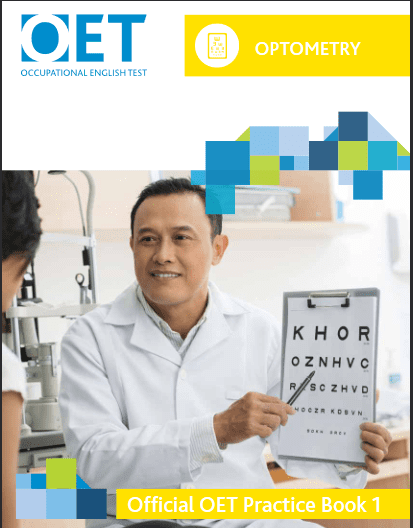
دانلود کتاب OET Optometry_ Official OET Practice Book 1_ For tests from 31 August 2019_nodrm
ناموجود
تمامی خدمات و سرویس های این مجموعه دارای اصالت و گارانتی پشتیبانی می باشد.
به راحتی هرچه تمام تر کسب و کار خود را شروع کنید (از صفر تا صد کنار شما خواهیم بود)
- تضمین بهترین قیمت بازار
- پشتیبانی عالی ۲۴ ساعته، ۷ روز هفته
- اصالت کالاها از برترین برندها
- تحویل سریع در کمترین زمان ممکن




نقد و بررسی وجود ندارد.